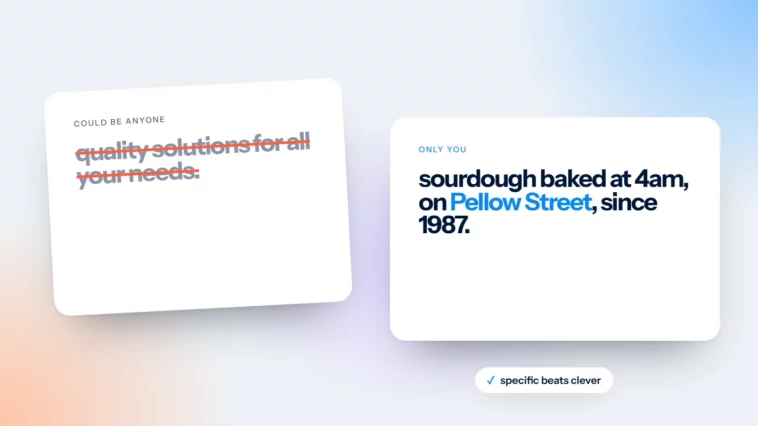
Say What Only You Can Say: Writing Website Copy That Stands Out
If a competitor could put your tagline on their sign, it isn't yours. Here's how to write lines that are.

October 2026
By The Qivox team
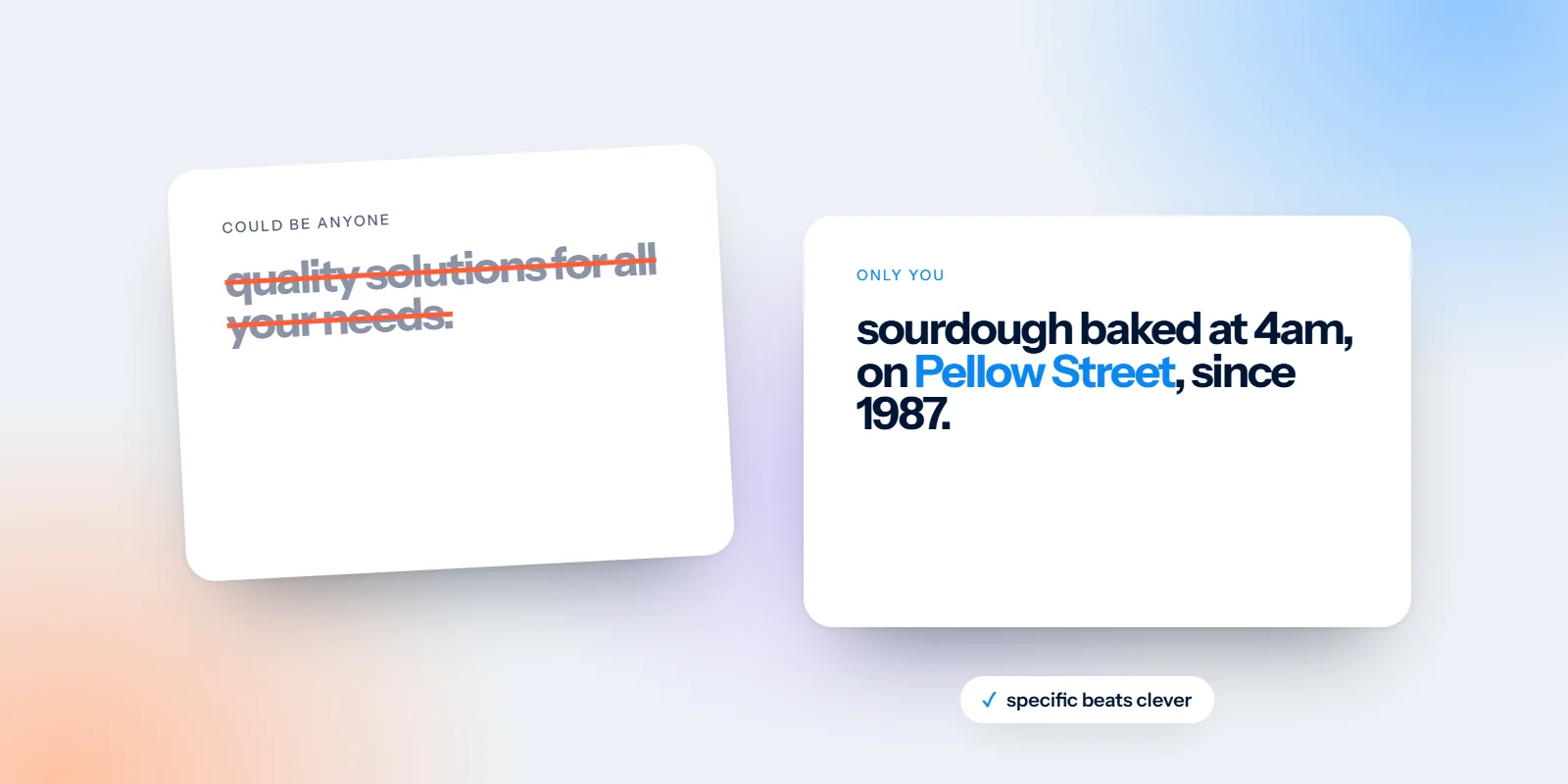
Read your homepage headline, then imagine it on a competitor’s shopfront. If it would fit without a single change, it isn’t doing its job. Lines like “Quality service you can trust” or “Your vision, our passion” sound fine, but they tell a visitor nothing they couldn’t assume, and they give nobody a reason to choose you. Good website copy is specific. It names things only you can claim: a place, a year, a method, a number. This article gives you a simple recipe, some before and after examples and a way to apply it across your whole site.
The competitor test
Before rewriting anything, find out how generic your current words are. Open your homepage and copy out the headline, the line under it and the first sentence of each section. Then open the sites of three competitors and do the same.
Now mix the lines up. If you can’t tell which belong to you, neither can your customers. Underline every phrase that could appear on any of the four sites: “high quality”, “friendly team”, “tailored to you”, “customer focused”. Those are the phrases to replace first. They aren’t wrong, they’re just unclaimable. Everyone says them, so nobody believes them.
The recipe: what you do, one proof, one detail
A line that only you can say usually has three ingredients. You don’t always need all three in one sentence, but between the headline and the line beneath it, you should cover them.
What you do: In plain words, the way a customer would describe it to a friend. “Sourdough bakery”, “family dentist”, “bookkeeping for creative studios”. No metaphors.
One proof: Something that makes the claim believable: a review rating, a guarantee you keep, a turnaround time, how long you’ve been doing it. Proof is what turns a promise into a fact.
One detail only you have: A place, a year, a method, a number. “Baked in Bath since 1987” is yours. “Fresh every morning” belongs to every bakery in the country.
Before and after examples
These are invented businesses, but the before lines are the kind we see on real sites every week.
Fresh every morning: Becomes: “Slow-proved sourdough, baked in Bath since 1987.” What it is, how it’s made and a place and year nobody else can copy.
Quality service you can trust: Becomes: “Same-week appointments. Fees on the website.” Two concrete promises that answer the questions people actually have. Trust is shown, not claimed.
Your vision, our passion: Becomes: “Websites for clinics, built in two weeks.” Who it’s for, what you make and a time frame a customer can plan around.
Excellence in every detail: Becomes: “Hand-stitched leather bags, made to order in our Leeds workshop.” A method and a place say more about quality than the word quality ever can.
Notice what the after lines have in common. They are slightly longer, they use ordinary words and every one of them could be checked. A customer can visit Bath, book a same-week appointment or count the two weeks. That is what makes them believable. A common mistake is to swap one cliché for a cleverer one, such as a pun or a play on words. Clever is fine for a social post, but your headline should be clear first.
If you have to say “quality”, you haven’t shown it yet. Replace the adjective with the detail that proves it.
Where to find your specific details
Most owners know these details so well they stop noticing them. Spend twenty minutes with a notepad and answer these questions: Where are you, and does that matter to customers? When did you start? How do you do the work differently, even slightly? What do customers praise most often in reviews, in their own words? Which numbers can you stand behind, such as turnaround times, years of experience or the number of projects you’ve finished? What do you refuse to do that others in your trade accept?
Your reviews are especially useful. Customers rarely write “high quality”. They write “the dentist explained everything before starting” or “the cake arrived exactly on time”. Those phrases are often better copy than anything a business writes about itself. Just make sure any number or claim you use is true and you can keep it true.
Writing website copy that stays specific on every page
Homepage: Headline with what you do and where, a line of proof underneath, then one clear button. Our note on homepage headlines has a formula you can use today.
Service pages: Open each with who the service is for and what they get, then the price or a “from” price. Specifics beat lists of benefits.
About page: Your story in facts: when, where, how and why. Skip the mission statement and show the method instead.
Buttons and links: Name the outcome: “Book a tasting”, “See our fees”, “Get a quote in 24 hours”. Specific labels are copy too.
Photos and captions: Words and pictures should make the same claim. A line about your workshop needs a photo of your workshop. Our guide to website photos explains why.
Make your brand easy to tell apart
Specific words are one half of a distinctive brand. The other half is how it looks: a logo, colours, type and photography that are clearly yours. Our brand identity service brings the two together, so your words and your look tell the same story everywhere from your homepage to your shop sign.
Not sure if your brand sounds like everyone else? Ask for a free brand review and we’ll show you what’s working and what we’d sharpen first.